

Aluminum foundry · Janikowo near Poznań
Sand casting – production of castings for industry
Aluminum sand castings – from single prototypes to series production, including complex shapes and large dimensions. We make molds and cores from self-hardening and heat-hardening sands, and we deliver castings with simplified technical documentation.
Sand casting foundry
Sand Casting – a Proven Technology for Your Production
Aluminum sand casting is one of the most widely used casting methods in the machinery, automotive and aerospace industries. Thanks to low production costs, manufacturing flexibility and the ability to cast complex shapes, this technology is used for both one-off prototype parts and industrial series.
Sand casting in brief
Sand casting, i.e. casting in sand molds, involves pouring liquid metal into a mold made of molding sand – quartz sand with a binder – formed on a pattern. Cores create the internal shapes of the casting. Low mold cost and great freedom of shape make the method well suited to prototypes, short runs and castings with complex geometry.
- Material
- aluminum alloys per PN-EN 1706
- Casting weight
- aluminum castings from 1 to 100 kg
- Molding flasks
- with dimensions up to 1000 mm
- Molding sands
- self-hardening and heat-hardening; automatic dosing and compaction
- Molds
- split molds on reusable patterns (series production) or unsplit molds on expendable patterns
- Documentation
- part design drawing and technical requirements for manufacture and acceptance

Download · 3 pages
Process Data Sheet – Sand Casting (PDF, 357 KB) (opens in a new window)
Technical parameters, molding sands and a sand mold diagram.
01 · Technology
Sand Casting Technology – Repeatability in Production
Precise and efficient production of series castings
For years, our foundry has been refining the sand casting process, supplying durable, precise and repeatable metal castings for a range of industries. With modern technologies and advanced quality control, we deliver castings with high strength and dimensional accuracy, tailored to the specific requirements of customers in the automotive, machinery, aerospace and energy.
We begin production by preparing sand molds made from a carefully selected mix of silica sand and binder, which allows faithful reproduction of fine details. In many cases we also use foundry cores, which make it possible to produce complex internal structures. We make patterns and core boxes in our own pattern shop – see patterns and prototyping.

Our sand casting technology provides:
- series production of castings with high repeatability,
- the ability to cast complex shapes and geometries,
- castings tailored to technical and strength requirements,
- finishing that ensures dimensional precision and a clean appearance.
After casting, every component undergoes quality control and, on request, machining, so that it meets technical standards and is ready for industrial use. Thanks to our experience, modern production methods and flexible approach, we deliver castings that meet the highest technological and quality standards.
02 · Coremaking
We use coremaking for accurate castings and control of the casting structure
Modern coremaking technologies in our foundry
We implement advanced coremaking processes that play a key role in shaping the internal structures of sand castings. Through precise core production and strict control of the casting structure, we ensure dimensional accuracy, uniformity and optimal mechanical properties in the finished components.
Depending on the intended use of the castings, we use different types of molds and cores:
Split molds with reusable patterns
Used in series production to maintain high casting repeatability.
Unsplit molds on expendable patterns
Used in more complex projects where reproducing intricate details is critical.
Through precise control of the composition and properties of molding sands, together with modern core compaction and stabilization techniques, we ensure structural consistency and high casting surface quality.
Every stage of coremaking and molding in our foundry is monitored to ensure the reliability and strength of the final products. Strict control of the casting structure allows us to eliminate defects and achieve the highest technical standards, meeting the requirements of industries such as automotive, aerospace, power generation or machinery manufacturing.
Through experience, modern technologies and precise control of every casting, we deliver durable, robust and perfectly fitted cast components to our customers, proven in the most demanding applications.
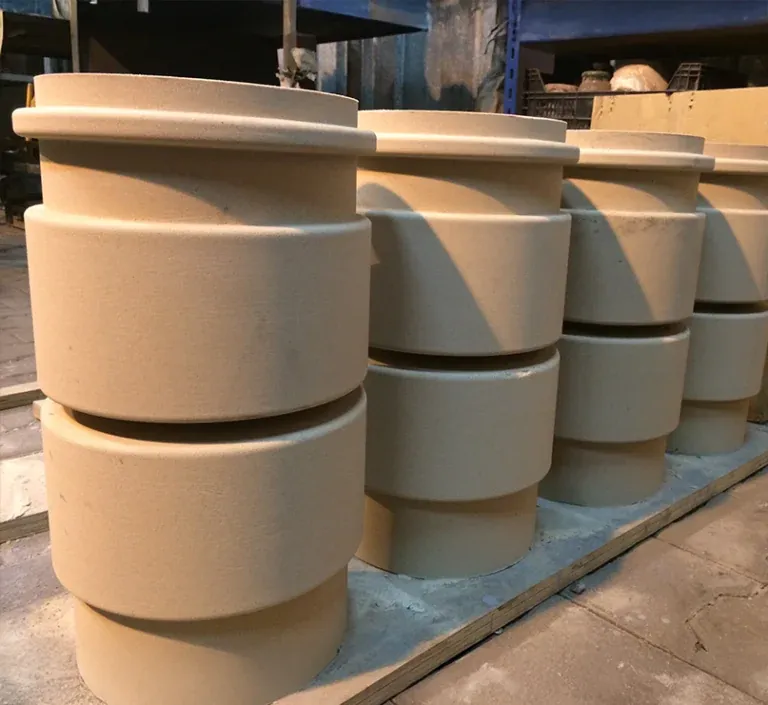
03 · Molding
We refine the molding process for the highest casting quality and precision
Mold making that ensures repeatability and dimensional accuracy
Molding is one of the most important stages of the sand casting process, directly affecting the quality, strength and dimensional precision of the castings. In our foundry we treat this stage with the utmost care, because correct mold formation is the key to castings with an excellent structure and dimensional repeatability.
Successful molding starts with selecting the right molding sand. Depending on the casting and its application, we use different sand mixtures, which undergo advanced preparation, mixing and compaction processes. Each sand must meet defined requirements for strength, plasticity and gas permeability to ensure uniform solidification of the metal and avoid casting defects.

In our molding shop we use modern automatic sand dosing and compaction systems, which let us maintain the highest precision on every casting. Depending on the project, we use:
Molding in self-hardening sands
Ideal for castings that require high stability and dimensional accuracy.
Molding in heat-hardening sands
Produces castings with exceptional mechanical properties and an excellent surface finish.
Casting structure control – every detail matters
A key aspect of molding is controlling the casting structure, which we do at every stage of the process. A high-quality mold ensures that the casting is free of imperfections, porosity and uncontrolled metal shrinkage. Our advanced molding methods produce components with a uniform structure, free of cracks and material defects, which is essential for parts used in the automotive, machinery, power generation and aerospace industries.

Modern molding is about efficiency as well as quality
Process automation and continuous monitoring of molding parameters allow us to significantly speed up production while minimizing the risk of errors and improving product repeatability. The result is castings of the highest precision that meet stringent quality standards and technical requirements.

In our foundry there is no room for compromise – every molding stage follows industry best practices and many years of experience. It is this precision and technology that make our sand castings reliable, durable and ready to perform in the most demanding industrial conditions.
04 · Scope and documentation
Sand castings from our foundry – scope and documentation
Sample aluminum castings from sand molds
We supply products from our aluminum foundry with simplified technical documentation, including the part's design drawing and the technical specifications for manufacture and acceptance. We produce aluminum sand castings weighing from 1 to 100 kg in flasks up to 1000 mm. The general acceptance rules are set out in our Technical conditions for casting acceptance.


05 · Choosing the process
When to choose sand casting?
Comparison with permanent mold and die casting
A sand mold has the lowest tooling cost, which makes it a good choice for prototypes, short runs and large, complex castings. For series where repeatable dimensions and a smooth surface matter, consider permanent mold casting, and for large series of parts with complex shapes – high-pressure die casting.
- Permanent mold castingPermanent moldRuns with repeatable dimensions and a smooth surface finish. Reusable metal mold, medium mold cost; castings from 0.1 to 50 kg.
- Sand casting · this pageSand moldPrototypes, short runs, large and complex castings. Lowest mold cost, made from a pattern; castings from 1 to 100 kg.
- Die castingHPDC dieLarge runs of parts with complex shapes and tight tolerances, often ±0.1 mm. Highest die cost, spread over many pieces.
06 · Ordering
How to order sand castings?
From drawing to series delivery
Drawing and quotation data
2D drawing in PDF and 3D model in STEP format, material or alloy, quantity per run and per year, and machining and coating requirements.
Analysis and process selection
We check feasibility, select the process and alloy, and prepare the die concept already at the quotation stage.
Die or pattern
We make casting patterns and core boxes – wooden, resin or steel – in our own pattern shop. See: patterns and prototyping.
Casting, machining and finishing
We cast the parts, trim off the gating systems and, on request, CNC machine, grind and powder coat them.
Inspection and Delivery
Inspection according to the drawing and technical acceptance conditions within an ISO 9001 system, with delivery in Poland and abroad.
We deliver the casting ready for assembly – after CNC machining, grinding or powder coating.
07 · FAQ
Frequently Asked Questions – FAQ
Sand Casting: Frequently Asked Questions
Sand casting is a proven, cost-effective technology for producing metal castings, offering high repeatability and dimensional accuracy. With modern molding sands and automated processes, we produce castings with complex shapes that meet industrial requirements in sectors such as automotive, power generation, aerospace and machinery.
We sand cast aluminum alloys. Each alloy is carefully selected for its mechanical properties, corrosion resistance and the operating conditions in which the finished castings will be used.
We begin the sand casting process by preparing sand molds made from high-quality silica sand and specialized binders. After the mold is filled with molten metal and the metal solidifies, the casting is cleaned and machined to achieve the required dimensional and visual parameters. Every finished component undergoes strict quality control to meet technical standards and industrial requirements.
We use modern molding systems that ensure high accuracy in reproducing shapes and dimensional stability of the castings. We use self-hardening and heat-curing sands, which deliver exceptional precision and surface quality. Thanks to automated molding processes, our castings offer repeatability and high strength.
Core making is a process that allows complex internal structures to be produced in a casting, which would be impossible to achieve with standard molding. At our foundry, we use both split and solid (one-piece) cores, which lets us reproduce geometry precisely and achieve optimal mechanical properties in the castings.
Every casting goes through multi-stage quality control, including:
- analysis of the composition and properties of the molding sands,
- monitoring of the casting structure and detection of any defects,
- precise dimensional measurements and strength tests.
These measures allow us to eliminate gas porosity, shrinkage porosity and other unwanted material defects, ensuring the reliability and long service life of our castings.
We produce aluminum sand castings in a weight range of 1 to 100 kg, in flasks up to 1000 mm in size. With modern molding processes, we can precisely adapt the size and geometry of castings to specific industrial requirements.
Our sand castings are used in many industries, including:
- automotive – castings of structural components, engine housings, drivetrain parts,
- aerospace – lightweight, high-strength elements of aircraft structures,
- power generation – turbine housings and casings, components of transmission systems,
- machinery – machine parts, production line components.
Automated molding delivers castings of repeatable quality, free of surface defects and distortion. With modern systems for mixing, dosing and compacting the molding sand, we eliminate the risk of errors, shorten production time and ensure optimal mechanical properties of the castings.
Yes, every casting from our foundry is delivered with simplified technical documentation, including the part's design drawing and the technical conditions for manufacturing and acceptance. This gives our customers complete information on the technical specification and the castings' compliance with industry standards.
Guides from the blog
More about sand casting
Contact and quote
Office open Mon–Fri 8:30 a.m.–4:30 p.m.
Contact
Sand Casting Quotation
Send a 2D drawing as a PDF or a 3D model in STEP format, and specify the alloy, casting weight and quantity. We will advise whether the pattern should be made of wood, resin or steel, and prepare a quotation.
Feel free to contact us by e-mail or phone
or visit us in person – you are welcome!
Janikowo near Poznań
62-006 Kobylnica
Office open Mon–Fri 8:30 a.m.–4:30 p.m.
Get directions (Google Maps, new window)Company details and directions: Contact page