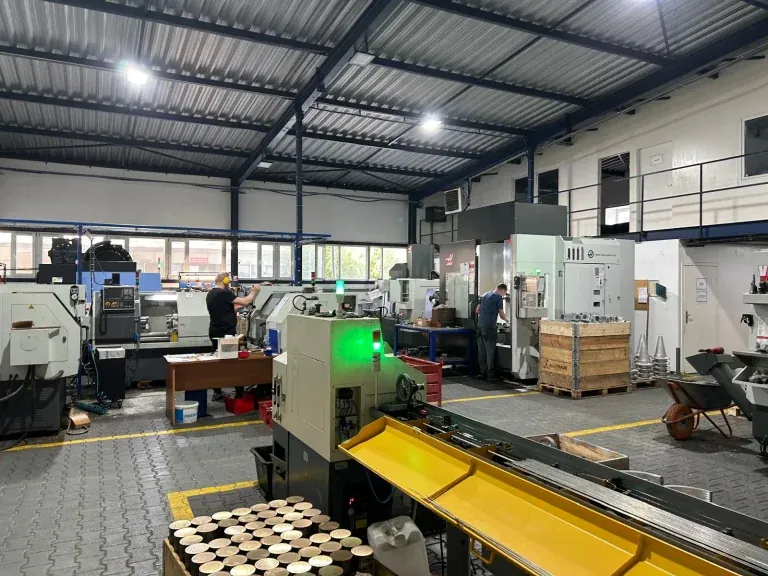

Machining of Aluminum Castings
Perfect accuracy in aluminum milling: how to achieve it?
Table of contents (6)
Milling aluminum is an art that demands precision and advanced expertise. In this article, we look at the key factors that make it possible to achieve ideal accuracy in this process. Have you ever wondered how important it is to choose the right tools and parameters? It is like a painter choosing the right brush: crucial to the final result. Let's dive into this fascinating field and find out how to achieve perfection in aluminum machining.
Let's start with the basics. Aluminum is a material that requires special care because of its softness and susceptibility to deformation. The right tools are only the beginning. Optimizing cutting parameters such as spindle speed and feed rate is like tuning a musical instrument: every detail matters. Choosing the right tools is like having the right key for a lock: without them, you will not get the result you want.
Temperature plays a key role in the milling process. If it is too high, it can lead to material deformation, which is the last thing we want. Managing temperature is therefore like controlling a fire: it must be properly regulated to avoid disaster. Did you know that coolant can significantly affect milling quality? It is like adding ice to a drink on a hot day: it not only cools, but also improves the taste.
Machine maintenance is just as important as every other element of this process. Regular inspections and maintenance are like taking care of your own health: they ensure longevity and reliability. Without proper maintenance, even the best machines can fail, which can lead to costly downtime.
In summary, achieving ideal accuracy in aluminum milling is a process that requires an understanding of many variables and how they interact. It is like an intricate dance in which every step must be executed with precision. With the right tools, optimized parameters and attention to detail, we can achieve the perfection we strive for. Are you ready to take on the challenge?
Choosing the right tools
In this article, we discuss the key aspects of achieving ideal accuracy in aluminum milling, including techniques, tools and process optimization strategies.
Choosing the right tools for milling aluminum is like choosing the perfect dance partner. They must be precise, reliable and perfectly matched to the task. But how do you find the ideal tools? This is a question that occupies many specialists. When it comes to precision and surface finish, both the material the tools are made from and their geometry are of key importance.
Because of its softness and susceptibility to deformation, aluminum requires a special approach. Cemented carbide and diamond tools often turn out to be the best choice. Why? Cemented carbide is extremely durable and wear-resistant, which means it can withstand intensive use without losing its sharpness. Diamond tools, in turn, although more expensive, offer unmatched precision and surface smoothness.
Tool geometry must not be overlooked either. The right rake angle and clearance angle can significantly affect the final result. It is therefore worth investing time in understanding which settings will work best for a given project. Here are some key factors to consider:
- Tool material: Choosing between cemented carbide and diamond.
- Geometry: Rake angle and clearance angle.
- Tool coating: Is it worth investing in tools with special coatings?
In summary, choosing the right tools for milling aluminum is not only a technical matter, but also a strategic one. It is like choosing the right shot in a game of billiards: it must be well thought out and precise to achieve the intended goal.
Optimizing Cutting Parameters
Optimizing cutting parameters in the process of milling aluminum is like tuning a musical instrument. Every element must be perfectly in place to achieve a harmonious sound, which in this case means ideal accuracy. But how do you do it? Let's start with the basic parameters, such as spindle speed i feed rate.
Spindle speed is simply the rate at which the tool rotates around its axis. Too high a speed can cause the tool to overheat, while too low a speed leads to inefficient cutting. The key is to find the sweet spot that delivers both productivity and precision. It is like riding a bike: go too fast and you may fall, go too slow and you will not reach your destination on time.
Feed rate, in turn, is the rate at which the tool moves along the workpiece material. Optimizing the feed rate makes it possible to achieve a surface smoothness that any master sculptor would be proud of. Wondering how to do it? Here are some key steps:
- Material analysis: Understanding the properties of aluminum makes it possible to adjust the cutting parameters.
- Trial tests: Running tests on small samples can help you find the ideal settings.
- Process monitoring: Continuously observe the cutting process and make the necessary adjustments.
We should also not forget the role of modern technology. Using advanced measuring systems i CAD/CAM software can significantly simplify the optimization of cutting parameters. It is like having a GPS in your car: you always know where you are and how best to reach your destination.
In summary, optimizing cutting parameters when milling aluminum is a process that demands precision and patience. With the right tools and approach, however, you can achieve accuracy that satisfies even the most demanding customers. Remember that the key to success is continuous improvement and adaptation to changing conditions.
Temperature Management During Milling
When milling aluminum, temperature control is like walking a tightrope. Why? Excessive temperature can lead to material deformation, which in turn affects dimensional accuracy. Aluminum, as a metal with high thermal conductivity, transfers heat quickly, but it is also prone to distortion if the temperature is not properly managed.
So how do you manage temperature to avoid these problems? The key element is applying the right cooling techniques. Consider using oil mist cooling or water-based coolant systems. Why is this important? Because coolant not only lowers the temperature but also lubricates the tool, which minimizes friction and extends tool life.
Let's take a closer look. During milling, heat is generated mainly by friction between the tool and the material. To manage temperature effectively, you can apply a multi-layer strategy:
- Temperature monitoring – using temperature sensors that continuously monitor heat in the machining zone.
- Spindle speed optimization – adjusting the tool's rotational speed to minimize heat generation.
- Using the right tools – selecting tools with coatings resistant to high temperatures.
These steps are like a well-coordinated dance, where every move is deliberate in order to achieve perfection. The ultimate goal is to maintain a stable temperature, which is crucial for achieving ideal accuracy in the aluminum milling process.
In summary, temperature management when milling aluminum is not just a matter of technique but also of strategy. It is like a game of chess, where every move must be thought through to achieve the final victory: a precisely machined part. Proper temperature management is the key to success and opens the door to excellence in metalworking.
The Effect of Coolant on Milling Quality
In the aluminum milling process, coolant plays a key role in ensuring high surface quality and extending tool life. But how exactly does coolant affect this process? Imagine that milling is like running a long-distance race. Without proper hydration, a runner quickly tires. Similarly, without effective cooling, milling tools can overheat, which leads to faster wear.
One of the main tasks of coolant is friction reduction between the tool and the workpiece material. This reduces the amount of heat generated during the process, which is crucial for maintaining stable dimensions of the machined part. Moreover, coolant helps remove chips, which prevents them from re-entering the cutting zone and potentially damaging the surface.
To better understand the effect of coolant, take a look at the table below, which presents the benefits of using it:
| Benefit | Description |
|---|---|
| Friction reduction | Reduces tool wear and improves surface quality. |
| Temperature Control | Prevents tool overheating and material deformation. |
| Chip removal | Helps keep the cutting zone clean, which increases precision. |
Choosing the right coolant is just as important as using it. Did you know that there are different types of coolants, such as emulsion oils and synthetic coolants? Each has its own unique properties and applications. That is why it is essential to match the coolant to the specific needs of the milling process.
In summary, aluminum is invaluable. Proper cooling doesn't just protect tools and material – above all, it guarantees the highest quality of machined parts. Keep in mind that choosing and applying coolant is like choosing the best sports equipment – it can significantly affect the final result!
The Importance of Machine Maintenance
In the world of precision aluminum milling, machine maintenance plays a key role. It's like taking care of your car – regular inspections and oil changes allow for long-lasting, trouble-free use. But why is maintenance so important in the context of milling?
First and foremost, regular maintenance ensures that machines run at maximum efficiency. This means every part of the machine works as it should, minimizing the risk of failure at the least expected moment. Imagine you are working on an important project and suddenly one of the machine's key components stops working. The cost of downtime can be enormous, both financially and in lost time.
Second, machine maintenance it directly affects production quality. Worn or malfunctioning components can lead to inaccuracies in machining, which with aluminum can result in defective products. Regular inspections and calibrations help maintain the highest quality, which is crucial in a competitive industrial environment.
What's more, maintenance also means savings in the long run. Although regular machine servicing may seem like an additional cost, it actually helps you avoid larger expenses for major repairs or replacing entire machines. It's an investment in the future that pays off in reliable, long-lasting equipment.
It is also worth mentioning the aspect of safety. Machines that are regularly maintained are less prone to failures that can lead to hazardous situations. Employee safety should be a priority for every company, and machine maintenance is one of the key elements of a safe working environment.
In summary, machine maintenance is not just an obligation but, above all, an investment in the quality, safety and efficiency of production. In aluminum milling, where precision and reliability are crucial, regular equipment servicing is the foundation of success. Let's remember that by taking care of our machines, we also take care of the future of our business.
Frequently Asked Questions
What are the best tools for milling aluminum?
Choosing the right tools is crucial! The best tools for milling aluminum are those made of cemented carbide, which provide high precision and durability. Did you know that the right cutting edge angle matters too? The right choice of tools is half the battle!
What cutting parameters are optimal for aluminum?
Optimizing cutting parameters is like finding the perfect rhythm in a dance. Spindle speed and feed rate must be matched to the specific material. Too fast a pace can lead to overheating, and too slow a pace to inefficiency. Finding the happy medium is the key to success!
Why is temperature control so important?
Temperature is the silent killer of precision. Too high a temperature can deform the aluminum, ruining the entire job. Maintaining the right temperature is like keeping a delicate balance – not too hot, not too cold, just right!
How does coolant affect the aluminum milling process?
Coolant is not just an extra – it's the real hero in the background! It helps keep temperatures low, which in turn protects tools and improves surface quality. Imagine it as a firefighter who puts out the fire before it starts!
Why is machine maintenance essential?
Machine maintenance is like regular visits to the dentist – not always pleasant, but absolutely necessary! Regular inspections and maintenance ensure that machines operate with the highest precision and efficiency. It's an investment that pays off!
Author: Poznań Foundry team
Poznań Foundry is a brand of Adjatech Metalworking Sp. z o.o., a family-owned non-ferrous foundry in Poznań. The Brukwicki family has been involved in foundry pattern making since 1950. We cast aluminum, brass and bronze in permanent molds and sand molds, and aluminum also by high-pressure die casting; we machine the castings on CNC machines and powder coat them. We operate under ISO 9001 and ISO 14001 management systems (certified by TÜV Rheinland Polska).