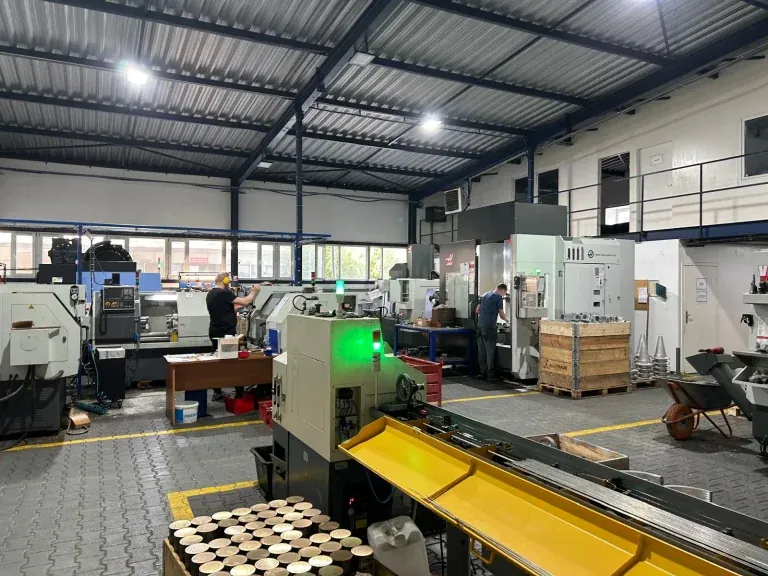
Machining of Aluminum Castings
Milling or Grinding? Choosing the Ideal Finishing Process
Table of contents (6)
Choosing between milling a grinding can feel like choosing between two completely different paths through a forest. Each of these finishing methods has its own advantages and limitations that can affect the final result. So how do you make the right decision? In this article, we take a closer look at the differences and applications of both techniques to help you make an informed choice.
First, it is worth understanding how these two methods actually differ. Milling is a process that removes material with a rotating cutting tool. This technique makes it possible to produce complex shapes and precise finishes. In turn, grinding is a method that uses abrasives to smooth surfaces, which is ideal for achieving smoothness and precise dimensions.
Choosing a method is like choosing the right tool for a specific task. Is the material you work with hard as rock, or delicate as porcelain? The type of material is critical, because not every method suits every type of surface. Milling may be the better choice for harder materials, while grinding works well for more delicate structures.
As for applications, both methods have their place in a range of industries. Milling is often used in heavy industry, where precision and durability are worth their weight in gold. On the other hand, grinding is indispensable in the production of components where every millimeter counts. Choosing the right method can be critical to the success of your project.
Costs and efficiency must not be overlooked either. The choice between milling a grinding can have a significant impact on the budget and lead time of a project. When analyzing costs, consider which method will deliver greater savings and better efficiency in the long run.
To better understand practical applications, it is worth looking at real-life examples. Many companies choose between these methods based on the specifics of their needs. For example, in the automotive industry, milling can be used to create complex engine parts, while grinding provides a perfectly smooth finish on car bodies.
In summary, the choice between milling a grinding is not simple, but understanding the basic differences and applications can help you make an informed decision. Each method has its own advantages that can pay off in different situations. Remember that the key to success is matching the method to the specific needs of your project.
Differences Between Milling and Grinding
Have you ever wondered what the difference is between milling and grinding? These two finishing methods are widely used in industry, but they differ in many respects. Milling is a process in which a tool rotates and removes material from the surface of the workpiece. In turn, grinding uses an abrasive tool that wears away material to create a smooth surface.
Technique is one of the main differences. Milling is more aggressive and can quickly remove a large amount of material, which makes it ideal for machining large surfaces. Grinding, on the other hand, is more precise and gentle, making it ideal for finishing and giving a part its final shape.
It is also worth noting the tools used in both processes. Milling uses cutting tools, which are usually made of hard materials such as cemented carbide, whereas grinding uses abrasive wheels, which can be made of materials such as aluminum oxide or silicon carbide.
When it comes to applications, milling is often used to create complex shapes and components in large machines, while grinding is used for surface finishing and ensuring that surfaces are smooth and flawless. It's a bit like the difference between a sculptor and a jeweler – one creates the form, the other polishes it.
In summary, the choice between milling and grinding depends on the specific needs of the project. Each method has its own unique advantages and limitations, so it is important to understand what matters most for your project.
Material properties and method selection
Choosing between milling a grinding can be like choosing between a hammer and a chisel — it all depends on what we want to achieve. The type of material is crucial. Why? Because each of these methods has its own unique characteristics, which may be more or less suitable depending on the hardness and structure of the material.
Imagine you are working with metal. For high-hardness materials such as stainless steel, milling often proves more effective. With precise cutting tools, milling can quickly remove a large amount of material, which is crucial in the production of industrial components.
On the other hand, when dealing with soft materials or delicate ones, such as aluminum or plastics, grinding may be the better choice. Why? Because grinding provides a smooth finish and minimizes the risk of surface damage. It's like using a delicate brush instead of a heavy hand to paint fine details.
The final choice of method also depends on the required finish quality. If the goal is to achieve high precision and smoothness, grinding can be invaluable. Milling, on the other hand, thanks to its versatility, is used where speed and efficient material removal matter.
In summary, both millingand the grinding have their place in the world of materials processing. The key is to understand the properties of the material you are working with in order to make the best choice. As the old saying goes: “There are no bad tools, only improperly used ones.”
Applications of milling and grinding
Milling and grinding are techniques that play a key role in various industries. Have you ever wondered how these methods affect production in heavy industry or in precision component machining? Here are a few examples that will help you understand where these techniques are used.
W heavy industry, milling is often used to machine large metal parts, such as machine components or steel structures. Thanks to its ability to remove large amounts of material in a short time, milling delivers efficiency and precision, which is essential in large-scale production.
On the other hand, grinding is indispensable when a very smooth surface is required. In the automotive industry, grinding is often used to finish the surfaces of engine components, where reducing friction and increasing efficiency are critical.
In the case of the production of precision components, such as electronic or medical parts, both milling and grinding play an important role. Milling allows precise shaping of parts, while grinding provides an excellent surface finish, which is crucial for both function and appearance.
It is also worth mentioning the use of these methods in the aerospace industry. Here, milling is used to produce structural aircraft components, while grinding plays a role in achieving perfectly smooth aerodynamic surfaces.
In summary, the choice between milling and grinding depends on the specific industry and the requirements for the final product. Both methods have their own advantages and are essential in modern industrial production. Isn't it fascinating how these techniques shape our world?
Machining Costs and Efficiency
Choosing between milling a grinding is not simple, especially when you consider costs i efficiency. Have you ever wondered how these methods affect your production costs? It is a bit like choosing between a fast car and an economical one – each has its advantages, but the choice depends on your needs.
Milling often involves higher initial costs, mainly due to advanced equipment and tooling. However, its efficiency in removing large amounts of material can offset these costs in the long run. Grinding, on the other hand, is more economical at the outset, but it may take more time, which affects the total cost of the operation.
To better understand how these methods can affect your production costs, let's consider a few key factors:
- Tooling and machine costs: Milling requires more advanced equipment, which means higher initial costs.
- Machining time: Grinding can be more time-consuming, which affects overall production efficiency.
- Energy consumption: Milling often consumes more energy, which can increase operating costs.
When comparing efficiency, it is also worth considering surface finish quality. Milling can deliver faster results on larger parts, but grinding provides a precise finish, which is invaluable in the production of high-accuracy components.
Let's look at a sample cost analysis:
| Method | Initial cost | Machining time | Efficiency |
|---|---|---|---|
| Milling | High | Medium | High for large volumes |
| Grinding | Low | High | High precision |
In summary, the choice between milling and grinding depends on the specific needs of the project. Do you need speed and productivity, or precision and finish quality? Ultimately, understanding the costs and efficiency of each method allows you to make an informed choice that best suits your production goals.
Practical Examples and Case Studies
This article discusses the differences between milling and grinding, helping you choose the right finishing method for various materials and applications.
Choosing between milling a grinding often depends on a company's specific needs and quality expectations. In many cases, this decision can be critical to the success of a project. Let's look at a few practical examples that illustrate how different companies make decisions on this issue.
The first case involves an automotive company that had to decide how to finish engine components. Milling proved more efficient because of its precision and speed, which was crucial for optimizing the production process. In this case, time is money, and milling made it possible to significantly shorten lead times.
In the furniture industry, on the other hand, a company producing luxury tables chose grinding for the final finishing of wooden surfaces. This produced a smooth, aesthetically pleasing surface, which was essential for maintaining the high quality of the final product. In this case, grinding made it possible to achieve an effect that was unattainable with other methods.
Another interesting example is a company that produces precision components for the aerospace industry. Here, milling i grinding were used together to achieve the required tolerances and surface quality. By using both methods, the company was able to provide customers with components that meet the highest quality standards.
In summary, the choice between milling and grinding is not simple and depends on many factors. Each company must analyze its own needs and expectations to make the best decision. Practical examples and case studies show that the right method can significantly affect the quality and efficiency of the production process.
Frequently Asked Questions
What is the difference between milling and grinding?
Milling and grinding are two different finishing methods. Milling removes material with a rotating tool, while grinding uses abrasives to smooth the surface. The choice of method depends on the requirements for precision and finish quality.
Which materials are best suited for milling?
Milling is ideal for machining metals such as steel and aluminum, as well as wood and plastics. It is important that the material is hard enough to withstand mechanical machining.
When should you choose grinding over milling?
Grinding is preferred when high precision and surface smoothness are required, especially for hard and brittle materials such as ceramics or glass. It is also a good choice for high-gloss finishes.
What are the costs of milling and grinding?
Costs vary depending on the material, the complexity of the design and the tooling used. Milling can be more expensive due to tool wear, while grinding may require less labor time but more electricity.
What are the most common applications of milling and grinding?
Milling is widely used in the automotive and aerospace industries to produce precision parts. Grinding is used in the manufacture of tools, molds and electronic components where a high-quality finish is required.
Can I use these methods in a home workshop?
Yes, many people use small milling machines and grinders in home workshops. However, it is important to always follow appropriate safety measures and to have adequate knowledge of how to operate these machines.
Author: Poznań Foundry team
Poznań Foundry is a brand of Adjatech Metalworking Sp. z o.o., a family-owned non-ferrous foundry in Poznań. The Brukwicki family has been in foundry pattern making since 1950. We cast aluminum alloys in permanent molds, in sand molds and by high-pressure die casting; we machine the castings on CNC machines and powder coat them. We operate under ISO 9001 and ISO 14001 management systems (TÜV Rheinland Polska certificates).