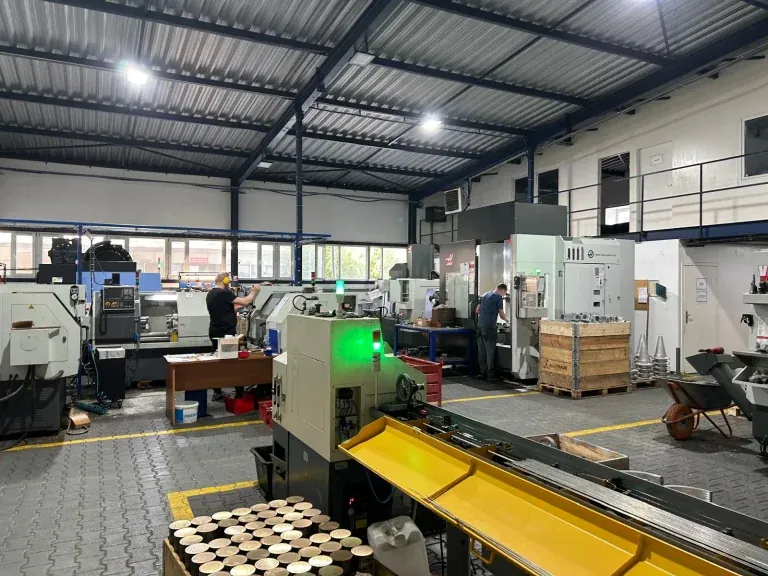
Machining of Aluminum Castings
Automating Casting Finishing: Is It Worth It?
Table of contents (6)
In today's dynamically developing industrial world, the question of the cost-effectiveness of automating casting finishing is becoming increasingly pressing. Is it worth investing in this technology, or is it better to stay with traditional production methods? There is no single answer, but it is certainly worth considering.
Automation, like any new technology, brings both opportunitiesand the challenges. On the one hand, we can expect increased efficiency i precision in production, which translates into lower costs of labor. On the other hand, implementing automation involves high initial costs and the need to train employees. It is a bit like buying a new car: the investment is large at first, but over time it starts to pay off.
It is also worth looking at how automation affects product quality. With precision machines, we can achieve accuracy i consistency in castings that would be difficult to obtain with traditional methods. It is a bit like the difference between a handmade watch and a machine-made one: both can be beautiful, but the latter will always be more precise.
In this article, we will also look at examples of applications of automation in various industries. Many companies are already implementing this technology successfully, which allows them to increase efficiency of production and improve quality of your products. It's like a game of chess: the more moves we can anticipate, the better our chances of winning.
Finally, let's consider the future of automation in foundry operations. What innovations might be on the horizon? Will automation become the standard in every plant, or will it remain the domain of only the biggest players on the market? The answers to these questions will shape the future of the industry.
In summary, automation of casting finishing is a topic worth exploring. It offers many benefits, but it also comes with certain challenges. The key to success is making skillful use of the available tools and technologies to achieve the best possible results. Are you ready for this revolution?
Advantages of Automation
Automation of casting finishing is a true revolution in industry. Have you ever wondered how to increase productivity and cut costs at the same time? It's like having a superpower in production! With automation, companies can reach a higher level of precision i efficiency. But how does it work in practice?
Imagine a machine that never gets tired and never makes mistakes. Automation makes it possible to introduce such machines into the production process, which means the work is done faster and more accurately than ever before. It's like having a team of robots working 24/7 without a break. Doesn't that sound like every business owner's dream?
We must not forget about reduced labor costs. With automation, companies can reduce the number of employees needed to operate machines, which leads to significant savings. Of course, the initial investment can be high, but the long-term benefits are invaluable.
In addition, automation affects the improve quality of products. Thanks to precision machines, castings are more uniform and accurate, which translates into greater customer satisfaction. Imagine that every product leaving the production line is identical and meets the highest quality standards. It's like having a magic wand that turns raw materials into perfect products.
In summary, automation of casting finishing is an investment that delivers measurable benefits. Higher productivity, lower costs and improved quality are just some of the advantages that speak in favor of implementing it. Are you ready for changes that could revolutionize your business?
Challenges of automation
Automation of casting finishing is a milestone in modern industry, but like any innovation, it comes with certain challenges. Is it worth taking them on? Absolutely. However, before we dive into the world of machines and technology, it's worth taking a closer look at what might stand in our way.
One of the most important challenges is the initial cost. Purchasing modern machines, software and infrastructure is a significant investment. Can every company afford it? Not always, but it's worth considering the long-term benefits. Automation can deliver savings that will eventually offset the initial expenses.
Another important aspect is training employees. New technologies require new skills. Can you teach an old dog new tricks? Absolutely! Proper training and education programs can prepare a team to use new tools effectively. Companies that invest in the development of their employees will certainly benefit in the future.
We also cannot forget integration with existing systems. Will the new technology be compatible with what we already have? It's a question worth asking before implementation. The integration process can be complicated, but with proper planning and technical support it can be carried out without major problems.
Finally, implementing automation may involve resistance from employees. Change can be hard to accept, especially when it affects daily work. That is why it is important to communicate the benefits of automation and involve the team in the change process. Employees who understand how technology can improve their work will be more willing to accept it.
In summary, the challenges of automation are real, but they are not insurmountable. With the right approach and planning, companies can implement new technologies effectively and strengthen their competitiveness on the market. As the saying goes, nothing ventured, nothing gained!
Examples of industrial applications
Automation of casting finishing is not just a trend, but a necessity in many industries. Wondering where this technology is used? The answer is simple: wherever precision i efficiencymatters. Modern factories and production plants are increasingly turning to automation to meet growing market demands.
The automotive industry is an excellent example. Car manufacturers such as Toyota or Fordare investing in advanced automation systems to increase productivity and improve the quality of automotive parts. Thanks to robots and intelligent inspection systems, processes such as machining engine blocks or gearboxes are more precise and less prone to human error.
The aerospace industry also benefits from automation. In the production of aircraft parts, where even the smallest inaccuracy can lead to disaster, automation is the key to success. Companies such as Boeing i Airbus use automated systems to machine components, achieving a level of accuracy never seen before.
We cannot overlook the energy industry. Manufacturing wind turbines or power plant components demands not only precision but also material strength. Automation optimizes production processes, which results in more reliable and durable products.
And what about the medical industry? Although it may seem surprising, automation is used here as well. Producing precision surgical instruments or implants requires exceptional accuracy that only automated systems can deliver.
In summary, automating casting finishing and machining is the future of industry. Whatever the sector, the benefits of implementing it are hard to overstate. Whether in automotive, aerospace, energy or medicine, automated processes are becoming the standard, and companies that adopt them gain a competitive advantage. Are you ready to join this revolution?
Impact on Product Quality
Automation in casting machining is like a magic wand that can turn mediocrity into excellence. Have you ever wondered how technology can improve the quality of manufactured products? It is like going from a black-and-white film to full-color reality! Thanks to automation, casting quality is no longer a matter of chance but a precisely controlled process.
A key aspect is accuracy. Automated systems can perform tasks with remarkable precision, eliminating human error. Imagine a robot that can repeat the same operations with an accuracy no human could ever match. It is like having the best sharpshooter on your team, one who never misses!
Another advantage is the consistent quality of consistency products. Automation maintains constant quality regardless of production volume. It is like baking perfect cookies every time, no matter how much dough you have. As a result, customers receive a product that always meets their expectations.
We must not forget about quality control. Modern systems can monitor every stage of production, identifying and eliminating problems before they become a serious threat. It is like having a guard watching over every production batch, making sure everything goes according to plan.
What are the results in practice? Companies that have invested in automation are seeing a significant improvement in the quality of their products. Examples from the automotive industry show that using robots in casting machining leads to fewer complaints and higher customer satisfaction. It is like winning a gold medal in the quality race!
In summary, automating casting machining is not only a step toward the future but also an investment in quality and competitiveness. Are you ready to join this race and leave the competition behind? Automation can be your key to success!
The Future of Automation in Foundries
Have you ever wondered what the future of automation in foundries will look like? It is a fascinating question that certainly occupies many specialists in the industry. As technology develops at a breakneck pace, automation is becoming a key element of the future of the foundry industry. But what innovations might await us in the coming years?
First and foremost, robotization will play an increasingly important role. Picture factories where robots precisely perform complex tasks, minimizing the risk of human error. As a result, product quality can be not only better but also more uniform. What is more, robots can work 24/7, which significantly increases production efficiency.
The next step in the evolution of automation is the Internet of Things (IoT). Thanks to IoT, machines can communicate with each other in real time, allowing better control of the production process. Imagine a system that automatically adjusts production parameters based on data collected from sensors. It is like an orchestra in which every machine plays its part in perfect harmony.
We cannot forget about artificial intelligence (AI), which is already starting to revolutionize industry. AI can analyze huge amounts of data, predict failures and optimize production processes. As a result, foundries can operate more efficiently, reducing costs and minimizing waste. A future in which AI manages the entire production process is no longer just science fiction.
It is also worth noting the development of 3D printing in foundries. Although the technology is still under development, its potential is enormous. 3D printing could transform the way we make casting molds, enabling the production of more complex shapes while reducing costs.
In summary, the future of automation in foundries is full of possibilities. Innovations such as robotics, IoT, AI and 3D printing can significantly change the way we produce castings. Are we ready for this revolution? Time will tell, but one thing is certain: the foundry industry is on the verge of major changes that can benefit both manufacturers and consumers.
Frequently asked questions
Is automating casting machining cost-effective?
Yes, automating casting machining can be very cost-effective. It increases throughput and precision and reduces labor costs. Although the initial investment can be high, the long-term benefits usually outweigh the costs.
What are the main challenges of automation?
The main challenges are the initial costs and the need to train employees. Companies must also adapt their production processes, which can take time and resources.
Which industries use casting machining automation most often?
Automation is widely used in industries such as automotive, aerospace and machinery. Examples include robots for precision finishing of castings and systems that monitor production quality.
How does automation affect product quality?
Automation can significantly improve casting quality by ensuring greater accuracy and uniformity. As a result, finished products are more consistent and meet higher quality standards.
What are the future directions of automation in foundries?
The future of automation in foundries includes the continued development of technologies such as artificial intelligence and machine learning. These innovations can lead to even more advanced and efficient production processes.
Author: Poznań Foundry team
Poznań Foundry is a brand of Adjatech Metalworking Sp. z o.o., a family-owned non-ferrous foundry in Poznań. The Brukwicki family has been in foundry pattern making since 1950. We cast aluminum alloys in permanent molds, in sand molds and by high-pressure die casting; we machine the castings on CNC machines and powder coat them. We operate under ISO 9001 and ISO 14001 management systems (TÜV Rheinland Polska certificates).