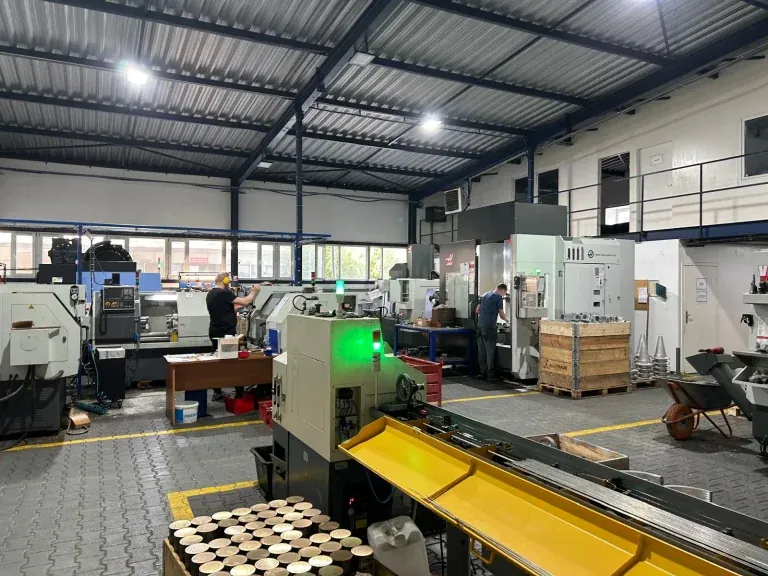

Machining of Aluminum Castings
Are 5-axis machining centers the future of casting production?
Table of contents (6)
These days, when technology advances at a rapid pace, the foundry industry faces the challenge of adapting to new standards. 5-axis machining centers are among the latest tools that could revolutionize the way we produce castings. Are these advanced machines the future of casting production? Let's take a closer look.
5-axis machining centers offer advanced capabilitiesthat enable more complex and precise operations. With them, modern casting production can reach a level of accuracy that was previously unattainable. In the past, producing complex shapes required multiple stages and machines, but now it can all be done in a single operation. It's like having a Swiss Army knife in the world of machines – one tool, many possibilities.
5-axis technology is not only about precision, but also about flexibility. It reduces machining time and production costs while improving the quality of finished products. Imagine a machine that works like an artist sculpting marble, creating a perfect work of art from raw material. With this technology, manufacturers can take on more complex projects without compromise.
Implementing 5-axis machining centers can lead to significant savings in production costs. How is that possible? Through more efficient use of material and shorter production times. It's like having a magic wandthat turns expenses into savings. In the long term, investing in this technology can deliver measurable financial benefits.
Looking ahead, the development of 5-axis machining centers points to their growing role in the foundry industry. We can expect further innovations and improvements that will increase their efficiency and availability. It's like riding a wave of innovation, where each new wave brings even greater possibilities.
Despite their many advantages, implementing 5-axis machining centers comes with certain challenges. High initial costs and the need for specialized expertise are just some of them. It's like climbing a mountain – it takes effort and preparation, but the view from the top is worth it. Companies must be ready to invest in equipment and training to fully exploit the potential of this technology.
In summary, 5-axis machining centers certainly have the potential to become the future of casting production. Their ability to increase the precision, efficiency and flexibility of production processes makes them an invaluable tool in the arsenal of modern industry. Are you ready to bet on the future?
The Importance of 5-Axis Machining Centers
Have you ever wondered how technology could revolutionize the casting industry? This is where 5-axis machining centerscome in. These advanced machines offer capabilities that were previously out of reach. Imagine an artist who can carve stone with laser precision — that's what these machining centers offer in the industrial world.
Thanks to movement along five axes, these machining centers can perform more complex and precise operations. But what does that mean in practice? It's like being able to view a picture from every possible perspective, so you can see every detail and nuance. Precision i detail are critical, especially in casting production, where every millimeter matters.
In a world where time is money, 5-axis machining centers also offer efficiency. They reduce the number of operations needed to produce a given part, which translates into shorter production times. It is like shortening a long journey with shortcuts and modern highways.
- Precision – the ability to reach levels of accuracy that were previously unattainable.
- Elasticity – the ability to perform complex operations in a single setup.
- Efficiency – reduced production time and costs.
In summary, the importance of 5-axis machining centers in modern casting production cannot be overstated. It is like holding the key to a new dimension of precision and efficiency. What do you think? Are you ready for the future these advanced machines offer?
Technological Advantages
5-axis technology is a true revolution in machining. Imagine a machine that can perform complex movements, much like a skilled sculptor creating a work of art with precision. Thanks to this technology, precision i flexibility machining reaches a new level. But what exactly do we gain?
First, reduced machining time. Because the machine can move in five axes simultaneously, it eliminates the need to repeatedly clamp and reposition the workpiece. This not only saves time but also reduces the risk of errors caused by human intervention.
Second, lower production costs. How is that possible? Imagine being able to optimize material utilization to the maximum. Less waste means lower raw material costs, which translates into more economical production.
It is also worth mentioning improved quality of finished products. Thanks to precise machining, products are more consistent and meet higher quality standards. It is like comparing handmade watches with mass-produced ones – every detail matters.
And now, let's take a look at flexibility this technology. 5-axis machining centers can be used in a variety of industries, from aerospace to medicine, which makes them a versatile tool for the future. It is like having a Swiss army knife in the world of machines – you will always find a use for it.
In summary, 5-axis technology is not just a step forward, but a real leap into the future of production. It allows us to achieve more, faster and with greater precision, which makes it invaluable in modern industry.
Impact on Production Costs
Today, when every company is trying to optimize its production processes, 5-axis machining centers are becoming a true game changer. But how exactly do they affect production costs? Is it worth investing in them? These questions concern many business owners.
First, implementing 5-axis machining centers can lead to significant savings. Their advanced capabilities allow more efficient use of materials. That means less waste and, consequently, lower material costs. Imagine being able to produce more parts from the same amount of raw material. It is like finding extra money in your pocket!
Second, production time is significantly shortened. Traditional machining methods often require multiple stages and machines, which lengthens the whole process. 5-axis machining centers, on the other hand, can carry out complex operations in a single pass. It is like a magic wand that speeds up everything you do. Faster production means more finished parts in less time, which translates directly into higher profits.
We must not forget about reduced labor costs. Fewer production stages mean fewer labor hours, which means lower payroll expenses. In addition, process automation reduces the risk of human error, which in turn minimizes the costs of rework and complaints.
But that's not all! 5-axis machining centers also offer flexibility, which allows you to quickly adapt to changing market needs. This lets you produce a wide range of products without major investments in new machines. It is like having a multifunction Swiss army knife in your factory.
In summary, investing in 5-axis machining centers is not just a step toward modernity, but above all a way to lower production costs and increase your competitiveness in the market. Is this the future of production? Everything indicates that it is!
The future and development of technology
In today's fast-evolving world the foundry industry, 5-axis machining center technology is becoming increasingly important. Why? This is because it offers previously unseen precision and flexibility. As the technology develops, its use is becoming more and more widespread, which is revolutionizing the way we produce castings.
Imagine a world in which every detail is a perfect fit, and production time is cut to a minimum. This is no longer just a vision of the future, but a reality made possible by 5-axis machining centers. With them, companies can produce more complex components faster and with less material waste.
However, to fully understand the potential of this technology, we need to look at its impact on the industry as a whole. What are the main benefits? Here are some of them:
- Cost reduction: Precision machining reduces the amount of scrap, which leads to savings.
- Increased productivity: Faster production processes allow higher output in less time.
- Innovation: The ability to create more complex shapes opens the door to new designs and applications.
The foundry industry is on the threshold of a new era in which 5-axis machining centers play a key role. Their development not only changes how parts are produced, but also affects the entire industry by introducing new standards of quality and efficiency. What will the future bring? We can certainly expect further innovations that will revolutionize this sector even more.
In summary, 5-axis machining center technology is not just a passing trend, but a lasting change that defines the future of casting production. Thanks to it, the foundry industry will be able to meet increasingly demanding market expectations, delivering top-quality products in a more sustainable and efficient way.
Challenges and limitations
Implementing 5-axis machining centers in casting production can be like climbing a mountain: full of challenges, but with the promise of spectacular views at the top. So what are the obstacles that need to be overcome?
First, high initial costs can be an insurmountable barrier for many companies. Investing in advanced technology requires significant capital, which may deter smaller businesses. However, as the saying goes, "nothing ventured, nothing gained."
Another challenge is the need for specialized expertise. Operating 5-axis machining centers requires trained personnel, which can be difficult to achieve in some regions. How do you find the right people who can fully exploit the potential of this technology?
It is also worth mentioning integration complexity with existing production systems. This process can be compared to assembling a complicated puzzle, where every piece has to fit perfectly with the rest.
We must not forget about maintenance and service. Advanced machines require regular servicing, which entails additional costs and downtime. So how do you keep production running smoothly and minimize the risk of failures?
In summary, although 5-axis machining centers offer enormous possibilities, implementing them involves a number of challenges. However, with the right approach and strategy, these barriers can be overcome, and the rewards for the effort can be substantial.
Frequently asked questions
What are 5-axis machining centers and why are they important?
5-axis machining centers are advanced machines that enable precise and complex machining operations. Their importance lies in the ability to produce complex shapes in a single setup, which increases the efficiency and quality of casting production.
What are the main advantages of 5-axis technology?
5-axis technology offers greater precision, flexibility and shorter machining times. This makes it possible to reduce production costs and improve the quality of finished products, which makes it essential for the modern foundry industry.
How do 5-axis machining centers affect production costs?
Implementing 5-axis machining centers can lead to significant savings through more efficient use of materials and shorter production times. Despite the high initial costs, the long-term financial benefits are substantial.
What challenges are associated with implementing 5-axis machining centers?
Implementing this technology involves challenges such as the high initial cost of purchasing machines and the need for specialized expertise and staff training. However, these obstacles can be overcome through proper planning and investment in workforce development.
What is the future of 5-axis machining center technology?
The future of 5-axis machining centers looks promising, with a growing role in the foundry industry. Further innovations and improvements are expected, which could increase their efficiency and range of applications across industrial sectors even more.
Author: Poznań Foundry team
Poznań Foundry is a brand of Adjatech Metalworking Sp. z o.o., a family-owned non-ferrous foundry in Poznań. The Brukwicki family has been involved in foundry pattern making since 1950. We cast aluminum, brass and bronze in permanent molds and sand molds, and aluminum also by high-pressure die casting; we machine the castings on CNC machines and powder coat them. We operate under ISO 9001 and ISO 14001 management systems (certified by TÜV Rheinland Polska).